
9 min read
5 EV charging trends reshaping the industry in 2026
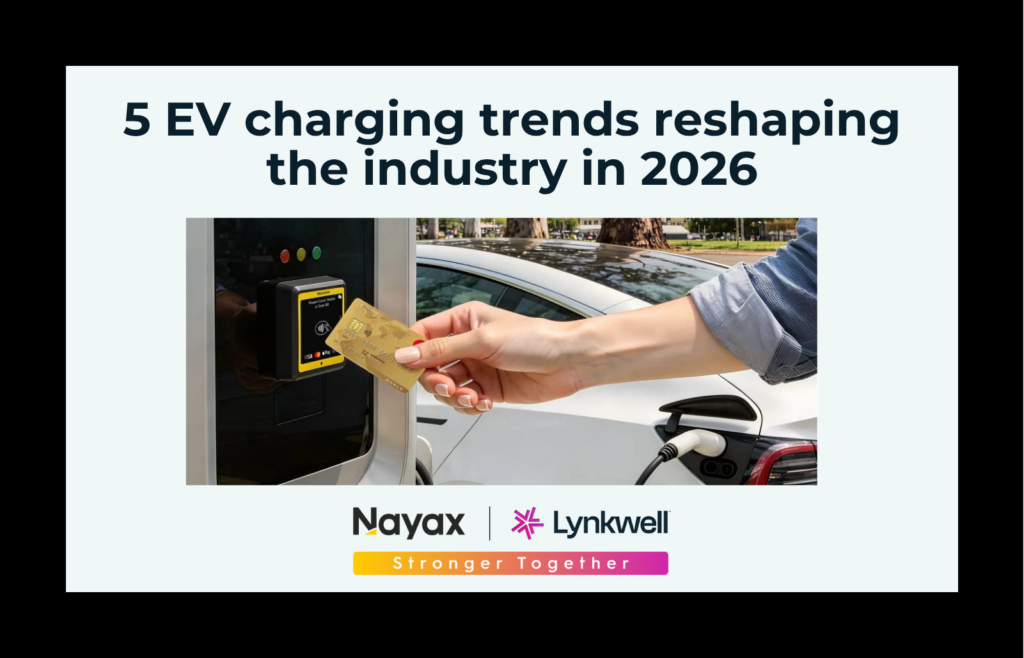
Australia’s EV market grew 38% in 2025. Over 156,000 electrified vehicles were sold. In March 2026, EV loan demand spiked 161% as fuel prices passed $3 a litre.
But here’s what those numbers don’t show: the experience at the charger hasn’t kept up with the cars arriving on the road.
Ask anyone who’s charged at a public station that isn’t a Tesla Supercharger. Multiple apps. Forced account creation. Unclear pricing. Payment screens that don’t respond. At a petrol station, you tap your card and drive away. At most public chargers, the process still feels like it was designed in 2015 — because it was.
That’s about to change. Whether you build EV chargers or operate a charging network, five trends are converging to reshape what the industry delivers — and what drivers, fleet managers, and regulators will accept. The common thread: the experience at the charger matters as much as the charger itself.
- Tap your card and charge – regulators are making it mandatory
The single biggest friction point in public EV charging is payment. And regulators worldwide are eliminating it by force.
The EU’s Alternative Fuels Infrastructure Regulation (AFIR), in effect since April 2024, requires all public DC fast chargers above 50kW to accept contactless bank card payments — debit or credit, tap-and-go, no app or subscription required. Pricing per kWh must be displayed before the session starts. By 2027, every fast charger must have a physical payment card reader.
In the US, the NEVI program mandates contactless payment that accepts major credit and debit cards at all federally funded chargers. No membership restrictions. No delayed power flow based on payment method.
In California, CARB’s regulation requires both EMV chip and contactless mobile payment hardware on all public chargers — ensuring the widest possible access regardless of what card or device a driver carries.
Australia doesn’t yet have equivalent federal mandates. But global supply chains are already aligning to these standards. Charger hardware built for EU and US compliance ships with contactless payment capability as the default. The question for Australian operators and manufacturers isn’t whether this standard arrives — it’s whether your infrastructure is ready when it does.
The business case is straightforward: networks that accept any bank card, any mobile wallet, on any charger see higher session completion rates, more repeat usage, and stronger revenue per charger. Payment friction doesn’t just frustrate drivers — it costs you completed sessions.
- Plug & Charge turns the cable into the payment method
Contactless cards solve the “no app” problem. Plug & Charge solves the “no action required” problem entirely.
ISO 15118, the international standard for vehicle-to-charger communication, enables a driver to simply plug in the cable. The vehicle and the charger exchange encrypted digital certificates, the driver’s account is verified, and billing starts automatically. No card. No phone. No screen interaction. Plug in. Walk away.
This isn’t a concept — it’s shipping. The EU requires all new public chargers to support ISO 15118 from 2026, with full Plug & Charge compliance by 2027. BMW, Hyundai, Porsche, Mercedes-Benz, Ford, and Lucid already ship vehicles with Plug & Charge certificates. EVgo reports that 30% of its sessions now use automatic authentication.
The payment industry is converging on this too. CharIN and EMVCo launched a joint project in September 2025 to align Plug & Charge with EMV-based open payment standards — so automatic authentication works with a driver’s existing bank card credentials, not a proprietary wallet. Mastercard is partnering with DEFA and Hyfer to embed payment credentials directly into the ISO 15118 flow.
The trajectory is clear: payment at the charger is heading toward invisible. For charger manufacturers, this means ISO 15118 support is becoming a spec requirement, not a feature upgrade. For operators, your payment terminal needs to handle both contactless card taps and certificate-based Plug & Charge sessions — seamlessly, on the same hardware.
- Ultra-fast charging compresses the payment window to seconds
When a charging session took 45 minutes, a clunky app-based payment process was tolerable. When it takes 15 minutes — or less — every second of friction matters.
Charging speeds are accelerating fast. BP Pulse’s new 24-bay hub at Melbourne Airport features 300kW chargers. BMW’s iX3, arriving in Australia mid-2026, supports 400kW peak DC charging. BYD is deploying 1MW charging stations globally, with 25 planned during 2026. The Megawatt Charging System (MCS) standard, developed by CharIN, targets heavy-duty vehicles at power levels that deliver a full charge in under 30 minutes.
A driver pulling into a 300kW charger for a 10–15 minute top-up has zero tolerance for a three-minute payment setup. The transaction needs to complete in the time it takes to plug in the cable — whether that’s a contactless tap, a Plug & Charge handshake, or a fleet card read.
For charger manufacturers: payment processing needs to be as fast as power delivery. A charger that can push 300kW but takes 90 seconds to authorise a payment has a bottleneck in the wrong place.
For operators: at a 24-bay hub running 300kW chargers, peak throughput depends on how quickly vehicles cycle through. If payment delays add even two minutes per session, that’s 48 lost minutes of capacity per cycle across the site. Instant payment isn’t a convenience feature — it’s a throughput multiplier.
- Charging hubs become retail destinations – and need retail-grade commerce
The lone charger bolted to a car park wall is giving way to purpose-built charging hubs: multi-bay sites co-located with retail, food, and services. This model changes the payment and operational requirements entirely.
BP Pulse’s Melbourne Airport hub — 24 bays, accessible stalls, drive-through options, amenities, canopy, 100% renewable power from onsite solar — is designed as a destination, not a utility point. In the US, EV Roadway’s hub at Vintage Oaks Shopping Center pairs ultra-fast 400kW chargers with major retailers — turning charge time into shopping time.
This model demands commerce infrastructure that matches the scale:
- Centralised payment processing across 20+ chargers at a single site, with consolidated reporting and reconciliation
- Dynamic pricing that adjusts per-kWh rates based on time of day, grid conditions, demand levels, and energy source
- Multiple payment methods on every charger: contactless cards, mobile wallets, fleet cards, Plug & Charge, and roaming tokens — all accepted on one terminal
- Remote management for operators to monitor payment terminal status, update pricing, and resolve issues across the entire site from a single dashboard
In Australia, the economy reinforces this shift. Kerbside AC chargers face facility access fees from distribution networks that can consume over 34% of revenue. Hub-scale deployments spread grid connection costs across more chargers, attract higher-value DC sessions, and create the commercial conditions for operators to build a sustainable business.
The operator’s question: can your payment infrastructure scale from one charger to 50 at a single site — processing contactless, fleet cards, Plug & Charge, and dynamic pricing — while giving you real-time visibility into every transaction?
- Fleet operators want one invoice, not 50 apps
Fleet electrification is accelerating across Australia. JET Charge forecasts up to 195,000 EV and PHEV sales in 2026, driven heavily by fleet buyers attracted to total cost of ownership advantages. The Toyota HiLux BEV will bring electrification to one of the country’s most popular commercial vehicle segments. Australia’s Vehicle Efficiency Standard, corporate decarbonisation pledges, and FBT exemptions are all adding momentum.
But fleet managers have a specific payment problem that public charging networks weren’t built to solve.
A fleet of 30 vehicles charging across multiple public networks generates dozens of separate accounts, separate apps, separate invoices, and separate pricing structures. Reconciliation is manual. Visibility is fragmented. Cost control is difficult.
The industry is responding. WEX launched its upgraded Fleet card with EV payment capabilities in January 2026 – the first fuel card to combine traditional fuel and public EV charging into one card, one account, and one invoice. Roaming protocols like OCPI and OICP allow fleet drivers to charge across multiple networks using a single credential, with settlement handled between operators behind the scenes. Depot charging requires load management across dozens of chargers, coordinated with shift schedules, energy tariffs, and site power limits- all integrated with fleet management platforms.
For fleet operators, the charger’s payment terminal is the point where operational data meets financial data. Every session needs to log which vehicle, which driver, which location, what cost, and what energy was consumed. That data feeds into fleet reporting, tax compliance, FBT calculations, and sustainability disclosures.
Fleet is the fastest-growing segment and the most demanding on payment and billing infrastructure. Operators and manufacturers who treat fleet billing as an afterthought will lose the customers who generate the highest utilisation and the most predictable revenue.
The charger is a commerce platform
These five trends point in one direction: the value of a charging station is increasingly defined by what happens between the driver and the payment terminal – not just between the cable and the battery.
Drivers expect tap-and-go simplicity. Regulators are mandating it. Plug & Charge is making it automatic. Ultra-fast charging is compressing the payment window to seconds. Hub-scale sites need retail-grade commerce. Fleet managers need consolidated, transparent billing.
The operators and manufacturers who recognise this – and build their infrastructure around payments, user experience, and operational convenience from day one – are the ones who will lead the next phase of EV charging growth.
The ones who don’t will have fast chargers that nobody wants to use twice.
Nayax is a global commerce enablement, payments, and loyalty platform designed for unattended and self-service environments – including EV charging. Active across 120+ countries with 80+ payment methods, Nayax helps charging network operators and charger manufacturers accept contactless cards, mobile wallets, and fleet cards on a single terminal, manage pricing and operations remotely, and deliver the seamless driver experience that builds repeat usage.
Read the original on Nayax.com
Related Insights
Discover news, perspectives, education and more from Lynkwell’s team of experts.